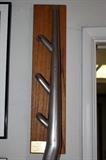
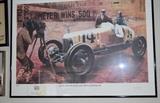
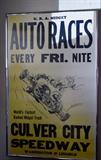
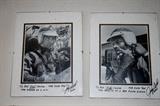
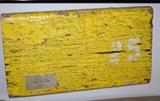
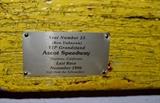
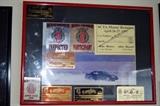
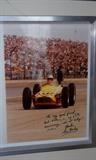
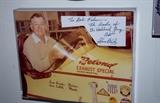
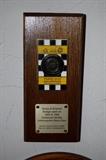
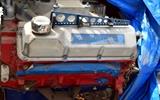
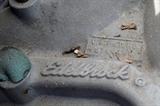
| | Bob Falcon was born on June 26, 1928 in Connellsville, Pennsylvania. His father was Lou Falcon, who made his living as an auto mechanic and participated as an owner-driver in auto racing events at half-mile horse tracks located in the area. "The only race track that I can recall was Jennerstown, Pennsylvania, where I took my very first ride around a race track in a race car, on my father’s lap during the warm-up. It was permitted in those days," Bob told me. Lou raced on the half-mile fairground tracks located in Western Pennsylvania, West Virginia and Maryland. His father's race car was a single seat Ford Model-T with a Frontenac cylinder head. The race car was demolished in a Labor Day race event in 1930 at Jennerstown Speedway. The race car was later rebuilt with a Rajo head and raced until the mid 1930's. Lou attended the Bear Manufacturing Company School in Rock Island, Illinois and became an auto wheel alignment specialist. Bob's mother, Carolyn DePolo, also came from Connellsville and worked as a telephone operator, before becoming a full-time housewife. Carolyn's father was Robert DePolo, who was born in the Italian Alps. Robert DePolo came to the United States when he was 10 years old to help his father install marble in a new railroad station being built at the time in Pittsburgh, Pennsylvania. After the father and son finished their stone masonry work on the train station, they returned to Europe. The young 10 year old DePolo dreamed of immigrating to America permanently. He knew there was plenty of work in this country for a young man and he stowed away on a ship going to America from Venice, Italy and landed in Buenos Aires, Argentina. He didn't know at the time that there was a South and a North America. DePolo eventually reached New York City and began working at numerous masonry jobs, then moving on to Pittsburgh. He specialized in Western Pennsylvania stone, of which he soon became well-known as an expert. Because of this skill, he was chosen by Frank Lloyd Wright, one of America's greatest architects, to cut the stone and do the masonry for Wright's Falling Water, the name of the summer home for the Kauffman family in Bear Run, Pennsylvania. Falcon grew up in Connellsville, an area noted for coal mining and illegal whiskey distilleries. His family made several attempts to move to California, traveling by auto in a 1934 Huppmobile, along the old Route 66, made famous by song. They would remain in Los Angeles for awhile, and return to Pennsylvania in response to family emergencies. Bob attended grammar school in Pennsylvania, and later in Redondo Beach, Los Angeles and Oakland, California. He remembers a two room parochial school in Dunbar, Pennsylvania that had grades one through 8. The town of Dunbar was established during the French and Indian War. The family finally settled in Southern California in January, 1942, shortly after the Japanese attack on Pearl Harbor, at the beginning of World War II. Bob attended Hamilton High School in West Los Angeles and his goal was to get out of school as fast as he could. He took auto and metal shop classes and only the required academic classes. Most of his friends were interested in cars, especially street roadsters. Bob's first car was a 1930 Ford Model-A Roadster powered by a four cylinder engine with a Cragar or Miller Schofield head, with the noted water jacket crack between cylinders number three and four. He became skilled in auto diagnostics in order to keep his car running. During his high school years, just after WWII had ended, he assisted two men in fabricating their track roadsters. One man was John Kelly, who raced with a group that called Culver City Speedway their home track. The other man was Sandy Belond, who raced with the California Roadster Association (CRA), which was later renamed the California Racing Association, when the CRA allowed sprint cars to compete. Belond went on to gain fame as a car owner and a winning sponsor at the Indy 500 race in Indianapolis, Indiana, probably the greatest and most well-known auto race in the world. Bob also assisted a returning war veteran, Burleigh Dolf, with the fabrication of a rear-engine lakes roadster. Also, at that time, he helped a Culver City neighbor, Dave West, who was serving as Chief Mechanic and build-supervisor, during the fabrication of the Howard Keck front-wheel drive Indianapolis race car. This beautiful car was driven in the Indy 500 by Jimmy Jackson in 1947 and '48, and by Maurie Rose in 1949 and '50. Jackson may have been the last driver to run the entire 500 mile race without a pit stop. During high school and due to his experience gained in fabricating race cars), Bob had charted what he wanted to do with his life. His high school academic counselor was a Physics teacher, Mrs Margaret Davis, and she altered his plans concerning his career path. She had developed a new course called Physical Science, which was made mandatory for students to pass before they could advance to the 12th grade. Mrs Davis was familiar with Bob's deportment, so she seated him right up in front of the classroom, near her desk. She gave course lectures and interpreted formula, which Bob recognized as matching the tasks needed to build race cars. Thanks to this, he passed the course with an A grade. Mrs Davis never realized how much she had helped Bob develop the love for science. Later, she apologized to him, wishing that she had recognized his aptitude for physics earlier, so that she could have inspired him towards the correct higher education path of an engineering career. Her efforts and recognition of this latent talent was a “wake-up call that changed his life. Bob also gained experience working in a gasoline station at night during the time that he was gaining experience building race cars. He joined the US Navy in October, 1947, hoping that he could learn a trade that would aid in building race cars after his tour of duty. Bob requested submarine duty from the recruiters and they assured him that it would be no problem, which turned out to be standard recruiting baloney in those days. After boot camp, rather than dispatching him to New London, Connecticut for submarine school, he rode on a small boat to the USS Dixie, a Destroyer Tender anchored in San Diego Bay. A few weeks later he was serving on the Dixie Deck Force, where you learn few skills other than housekeeping chores and was enroute to Tsingtao, China. Bob had a front row seat for the final days of the Chinese Revolution, as he was cruising through the Formosa Straits headed for Hong Kong on his 21st birthday. While stationed in Japan during the Korean War, he bought a set of drafting tools and taught himself mechanical drawing. Bob had convinced a shipmate who owned a Model-A Ford that was back in the states, that they could fabricate a finned, aluminum cylinder head for the car. The shipmate worked in the on-board foundry so they embarked on the project. When the design was completed the pair fabricated all the patterns and tooling needed to cast the head. The Dixie was a naval repair ship and had many shops and equipment specialized for making parts to maintain a destroyer class ship in time of war. Bob found that he learned many skills on board the Dixie that applied directly to race car fabrication. He was riding his Ariel Twin motorcycle when he suffered a serious ankle fracture when his leg hit a fence post at 50 miles per hour (mph), while rounding a corner. This led to a year of rehabilitation in the Naval Hospital at the Camp Pendleton Marine Base, in Oceanside, California. Bob was discharged in 1952 and re-entered civilian life. He could not qualify to study engineering on the GI Bill, so he worked at an aircraft plant, AiResearch, and took night classes in mechanical engineering at several local community colleges. He looked forward to using his military skills and training to build a race car and drive it on oval tracks, just like his dad had done back East. He also received some good GI Insurance that covered race car drivers. Bob began Jalopy racing at Culver City Speedway, serving on the crew of a car owned and driven by an old friend, Dick Long, in 1953. At that time Jalopies were the entry level for aspiring race car drivers. Dick let him drive the car during warm-up laps, and later allowed Bob to drive the car in the Hooligan event, the race for non-qualified cars and new drivers who needed seat time. Bob's first race lasted just one-half lap as he somehow found the car teetering atop the crash wall in the back straightaway. As Bob gained seat time driving for other car owners, he received a great deal of driving advice from Van Johnson, a driver who was transitioning into the Midget ranks. As his racing skill level advanced under Van's tutelage, Bob designed and built a very advanced car for that time when Jalopies had evolved into decent racing machines. The "Hard Tops," as the early NASCAR class was called, were considered a step down from the Jalopies in those days. Bob's 1932, 5-window coupe, which germinated from drawings and sketches produced when he came home from working the swing shift at AiResearch, was perhaps the very first of these Jalopy class cars built from the frame up. It was an extremely light race car, which set two records simultaneously at the Long Beach Veterans Memorial Stadium for speed and altitude. He had trouble during the final qualification lap when a steering U-joint failed. The car struck a crash wall gate, which was unlatched and swung open, then hit a huge fence post head-on and soared to a height estimated to be 40 feet. The car then tumbled down the front straightaway, end-over-end for 60 or 70 yards. The timer stopped the clock manually as the car cleared the lights, although he was extremely high and he had set a new qualification record. The chrome-moly roll cage proved to be quite strong. At the time he was racing at Culver City and Long Beach, Jalopy racing was the toughest competition in all of auto racing, which was confirmed by Parnelli Jones. Each Sunday there were over 200 cars checked in through the Pit Gate. All the entrants received three attempts at qualifying for the program and the fastest 16 would race in the Main Event and this was the only way you received a spot in the starting grid for the feature. The field was inverted with the fastest car gridded in the rear of the starting grid. The time spread between the 16 fastest qualifying cars was a mere one-half second. The track was a ¼ mile, dirt surface and the lap time was approximately 14.5 seconds. If you qualified for the feature on a regular basis, you were considered to be a pretty good race driver. The 17th through the 32nd fastest Jalopies would race in the Semi-Main Event, while all the other drivers made the hooligan event. An opportunity to drive sports cars with a new organization that paid prize money presented itself and Bob stopped driving Jalopies. He raced in the under 1500cc Production class driving an MG-TD, which was owned by Bob Anderson. Working together, Anderson and Falcon converted the MG to a neat little race car that handled really well on the ovals, which the new racing group scheduled to host events, a rarity for sports cars. Most remarkably, this little 1250 cc car beat several Porsches on the Bonelli Stadium race course, which was a 1/3 mile, very flat, paved oval. Anderson sold the car after he got married and Falcon lost his ride, but advertised for work as a driver in the RRR newsletter. Whitey Thuessen answered the advertisement and invited Falcon to visit his shop for a meeting. The meeting turned out to be a fit check for Thuessen's Offy Special. Whitey told Falcon that he also got him a ride in an XK140 Jag. Bob won the very first race he drove for the Jag's owner, Jack Furcho. In this initial outing at Willow Springs Raceway, Falcon started from the 27th and last place on the grid in a standing start and won the event, the very first victory for a Furcho car. In true 'Falcon Fashion,' he also set an Altitude Record in this car at Orange County Fairgrounds, in Costa Mesa, California. Furcho planned to purchase a new Jaguar C Model for Bob to drive, but a disagreement between Falcon's wife at the time and Furcho’s wife, soured the deal. This led to Furcho dismissing Bob and hiring a new driver. The argument between Furcho's wife and Bob's wife, and his subsequent loss of his job put a strain on his first marriage that ended in divorce. During this period Bob also made many racing friends who came to his father’s shop for help on their race cars. Many of these young men belonged to the Russetta Timing Association, which held land speed time trials in the Southern California deserts. Russetta was one of many timing associations holding time trials for young men eager to test their cars against the clock. For one reason, or another, Bob did not run a car at the dry lakes or Bonneville at this time in his life, but he did compete at the Santa Ana Drags several times. He would drag race on Sundays when a Jalopy race was not scheduled. Most of his friends were members of the Screwdrivers car club and several were well-known in dry lakes racing; Jerry Bondio, Craig Breedlove, Cecil Sutton and Nick Arias to name a few. Bob went to work for Halibrand Engineering in 1963 and stayed with the company for over 30 years. His first assignment was on the design crew of the Halibrand Shrike Indianapolis cars starting in 1963 and ending in 1966. He made his first trip to the Indianapolis 500 in 1964. Falcon also served on the Halibrand Engineering staff for the feasibility study vehicle for the Linear Induction Motor (LIM) technology. This work was to gauge the performance of a magnetic powered train. This study vehicle was fabricated in the 1970's at the Halibrand Engineering shops. The LIM was clocked just a few ticks less than 260 mph at the DoT high speed test track in Colorado. LIM technology formed the basis for today’s Mag-Lev high speed transportation systems. Bob also worked for Echlin Manufacturing as a Field Service Engineer for their Accel ignition product line. As Racing Director for Echlin, which is the parent company for Accel, he supervised a crew of Field Service Engineers that covered the National Hot Rod Association (NHRA) and the International Hot Rod Association (IHRA) drag racing circuits and the Indianapolis 500, including the USAC National Championship events. Among the Accel product line the top end was the Breakerless Electronic Ignition (BEI) which was developed by Dawson Hadley when he worked for Tom Spaulding’s Ignition Company, located in Monrovia, California. Falcon covered the USAC and Indianapolis events by himself. One of the BEI equipped teams was the Lindsey/Hopkins/McLaren car driven by Roger McCluskey. This car won the 1972 Ontario 500 and the 1973 USAC National Championship. It may have been the first car equipped with an electronic ignition to win the title. Bob also served as the secretary of the USAC Safety Committee and served from 1975 until 2005. It should be noted that this was in the period in which the most progress was made in mandating safety modification to USAC race cars, which carried over to many other car types. This was when fire was the major cause of most deaths in racing. USAC was considered the leader in safety improvements and it was during this period that Bob developed the Shoehorn Rapid Extrication Device (SRED) to aid in the rescue process of extricating injured race drivers from the tight cockpits of Indy cars. At the present time this device is the extrication tool of choice by the world's leading racing organizations. In 2005, Bob was awarded the first Indy Racing League/Delphi Annual Safety Award. This award is presented to the one person or company each year, in recognition for their contribution to racing safety. In 2006, Bob was awarded the Annual Pioneer in Racing Award by the American Auto Racing Writers and Broadcasters Association (AARWBA). Both of these prestigious awards were presented in recognition of Bob’s development of the Shoehorn Device and the lives it has saved through the years. He also worked in the aerospace industry with Sargent-Fletcher Inc (SFI), in El Monte, California. SFI specializes in aircraft external fuel tanks, special under wing equipment pods and aerial refueling systems. Since leaving SFI, he has been engaged in the promotion of the Shoehorn Device, and to introduce it to the nation's municipal fire and rescue departments. This life and lifestyle saving rapid extrication tool is the device of choice by use, of every major auto racing organization in the world and most of the US super speedways. In 1992, Bob purchased a brand new Ford Taurus SHO. His friend, Jerry Bondio, convinced him that they should try racing it at the Southern California Timing Association (SCTA) time trials. After a few tweaks and relying on Bondio’s and George Bently’s past dry lakes and drag racing experience, Bob drove it to a new F Production class record at Muroc Dry Lake, on the grounds of Edwards AFB), with a 137.709 mph clocking. The Taurus was a 3600-pound, four-door sedan powered by a normally aspirated 3.0 liter engine. The car is now up for sale. Bob has been married twice, first to Wanda Fry. His second marriage was to Sondra (Sandy) Roberds and that marriage also ended in divorce. His oldest daughter is Cynthia Falcon, who lives in Kodiak, Alaska and teaches at the University of Alaska in Social Sciences. His second child is his son Christopher Falcon, who lives in Morris Plains, New Jersey and is the manager for IC Network, a manufacturer of medical stents. His next child is Robb Falcon who lives in Simi Valley, California and works in the home loan business. Michelle Lehman is his next daughter, and though she is a stepchild, Bob loves her very dearly. Michelle lives in Altadena, California and is the Vice President of the Human Resources department for West Corp, a very large banking industry services provider headquartered in Azusa, California. Evan Falcon is his youngest son, just one month younger than Michelle, and he lives in Santa Rosa, California and is the Executive Vice President for an IC company located in Rohernet Park. Evan worked for Bob Bondurant when he had a driving school located in Sonoma at Sears Point. Falcon has discovered a recent talent for literature. He has had three By-Line stories published in a national auto racing pocket magazine. 'TheAlternate' is a magazine that specializes in items concerned with racing nostalgia. The Southern California Chapter of the Society of Automotive Historians (SCCSAH) selected his story concerning the factual history about the Distarce brothers. The Distarce's created a regular schedule of weekly Midget auto races at close-by neighborhood race tracks in 1933. Falcon's story was the winner in the periodicals category of the SAH's annual Valentine Memorial Award for literature. Bob also enjoys membership in two prestigious organizations, The Indianapolis 500 Old-timers Club (a 20-year member) and the Quiet Birdmen, Long Beach Hangar. |